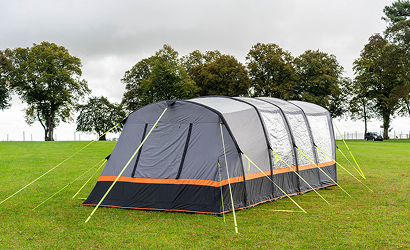
Written by Lisa Walton on 23rd Mar 2026

We've been designing inflatable tents at OLPRO since we launched our Breeze range. We've watched them go from a curiosity that campers didn't trust to the fastest-growing category in the tent market. And we've spent years solving the problems that early inflatable tents had: slow valves, unreliable seams, beams that softened overnight.
If you're considering an inflatable tent, you've probably got questions. Are they actually reliable? What happens if they puncture? Will they survive a windy weekend in Wales? This guide covers all of it, honestly, including the bits that other brands would rather you didn't ask about.
How Inflatable Tents Actually Work
An inflatable tent replaces traditional metal or fibreglass poles with air-filled beams. You pump air into them using a manual or electric pump, and they become rigid enough to support the tent structure.
The beams aren't like a pool float. They're made from TPU (thermoplastic polyurethane). a tough, flexible material that resists punctures, UV damage, and abrasion. Each beam sits inside a protective fabric sleeve that takes the main wear.
Here's what happens when you pitch one:
1. Lay out the tent and peg the corners
2. Connect the pump to the first beam's valve
3. Pump until the beam is firm (around 7 PSI on our Breeze range)
4. Move to the next beam and repeat
5. Peg out the guy lines and tension the fabric
Our tents have 5 individual beams, each with its own valve. This is a deliberate design choice; if one beam loses pressure, the other four keep the tent standing. Some cheaper designs use a single inflation point for all beams, which is faster to inflate but means the whole tent goes down if there's a problem.
Realistic pitch times:
Our Abberley XL Breeze takes about 25-30 minutes from bag to fully pitched and pegged. The Blakedown Breeze is similar. The Discovery, being larger at 6-berth, takes around 30 minutes. These are real-world times, one person, on a campsite, including pegging out. Marketing claims of "under 10 minutes" usually mean inflation time alone, ignoring layout, pegging, and tensioning.
Inflatable vs Pole Tents: The Honest Comparison
We make both. Our poled tents (Stafford, Orion, Wichenford, Kinver) use fibreglass poles. Our Breeze range uses air beams. If you're still deciding between tent types, our guide to choosing the right tent covers the full picture. Here's the genuine trade-off:
The Abberley XL illustrates this perfectly: the inflatable Breeze version is £499. The poled version is £259. Same tent design, same fabric, same bedroom layout. The difference is entirely the frame system.
When inflatable wins
You camp regularly and value easy pitching. You often pitch alone. You camp in exposed or windy locations. You're happy with the higher price for the convenience.
When poles win
Budget matters most. You want the lightest possible tent. You backpack or carry gear a distance (air tents are car camping tents — they're too heavy for anything else). You camp infrequently enough that the slower pitch time doesn't bother you. Check out our full tent range if you want to compare poled and inflatable side by side.
Wind, Rain and Weather: What to Expect
This is the question we get asked most. And the answer is genuinely positive.
Wind
Air beams perform well in wind, arguably better than rigid poles. When a gust hits, a rigid pole resists until it snaps. An air beam flexes, absorbs the energy, and returns to shape. It's the same principle as a tree bending in a storm rather than breaking.
Our tents are designed to handle winds up to 55mph when properly pegged and guyed. That's a strong gale, not pleasant camping weather, but the tent will stand.
Pegging matters more than the tent
An inflatable tent is only as wind-resistant as its pegging. Use every peg point. Tension every guy line. On soft ground, use longer pegs driven in at 45 degrees. Don’t skip the storm straps — they’re included for a reason.
Rain
All our inflatable tents have a 5,000mm hydrostatic head rating, meaning the fabric can withstand 5 metres of water pressure before a single drop comes through. For context, 3,000mm is considered good for UK camping. 5,000mm handles anything the British weather can throw at you.
Every seam is fully taped. Every groundsheet is sewn in. Rain isn't a concern with a properly made inflatable tent.
Temperature Changes and Beam Pressure
This is one that catches people out. Air pressure changes with temperature. On a warm afternoon, you inflate your beams to 7 PSI. Overnight, the temperature drops 10 degrees and the air contracts, the beams soften slightly. By morning, the tent can look a bit saggy.
Beams gone soft overnight?
It’s not a leak, it’s physics. Air contracts as temperature drops. A few extra pumps in the morning sorts it. Experienced air tent campers do this automatically, like boiling the kettle, part of the morning routine.
The Condensation Question (And What to Do About It)
Most inflatable tent guides skip this topic entirely. We won't, because it's the biggest genuine frustration with air tents and you deserve to know about it before you buy. We've written a full guide to avoiding condensation in tents and awnings if you want the deep dive — here's the summary.
Why condensation happens more in air tents
All tents get condensation. It's physics; warm, moist air from breathing, cooking, and body heat meets a cooler tent surface and water forms. But inflatable tents can be worse for condensation than pole tents for two reasons:
1. Air beams create temperature differentials. The air inside the beams is cooler than the air inside the tent, creating cold spots on the beam sleeves where moisture condenses.
2. Most inflatable tents use polyester. Polyester is lighter and cheaper than polycotton, but it doesn't absorb any moisture, every drop stays on the surface as visible condensation. Polycotton absorbs moisture into the fabric and releases it gradually, which is why traditional canvas tents feel drier inside even though they're not.
How to Manage it
You can't eliminate condensation, but you can reduce it dramatically:
The golden rule
Ventilation is everything. Open vents and mesh panels whenever possible, even in cool weather. Air circulation prevents moisture building up on surfaces. Our tents have multiple door and window configurations specifically for creating through-ventilation.
- Don't cook inside your tent. A single-burner stove produces a surprising amount of moisture. Cook under the canopy or outside.
- Don't dry wet clothes inside. Hang them outside or under the front canopy.
- Wipe down in the morning. A quick wipe with a microfibre cloth takes five minutes and stops water dripping onto your gear. Do this while the kettle's on and it becomes second nature.
- Use a footprint groundsheet. Moisture rising from the ground underneath contributes to condensation. A footprint underneath the tent reduces this.
- Is condensation a dealbreaker? For most people, no. It's manageable with good habits. But if you're camping in late autumn or winter when temperature swings are extreme, be realistic, you'll get condensation in any single-skin tent, and an air tent is no exception.
How Long Do Inflatable Tents Last?
A well-maintained inflatable tent should last 5 to 10 years of regular use. Some of our early Breeze customers are still using tents from our first production runs.
The air beams themselves are the most durable component, TPU doesn't degrade the way fabric does. It's usually the outer fabric that ages first, through UV exposure and general wear. That's why we use fabrics with UV-resistant coatings and why storing your tent out of direct sunlight when not in use matters.
What actually kills inflatable tents
The #1 tent killer: storing it damp
Mould and mildew destroy fabric and will ruin a tent in a single winter. Always dry your tent thoroughly before packing it away for storage. If you can’t dry it on site, unpack and air it out at home within 48 hours.
2. UV exposure over time. Leave any tent pitched in direct sun for weeks and the fabric degrades. For extended stays, consider a sun canopy over the tent or pitch in partial shade.
3. Over-inflation. More pressure isn't better. Inflating beyond the recommended PSI stresses the beam seams. Stick to 7 PSI for our Breeze range.
4. Rough handling. Dragging the tent across gravel, shoving it into its bag without folding, or forcing zips, these cause the incremental damage that adds up over years.
We put a lifetime warranty on our tents and awnings because we're confident in how long they last. If a beam fails due to a manufacturing defect, we replace it. Individual replacement beams are also available if you need one down the line.
How to Choose an Inflatable Tent
Three decisions, in this order:
1. How many people are actually sleeping in it?
Tent "berth" ratings are maximum capacity, not comfortable capacity. A 4-berth tent sleeps 4 people who don't mind being close together. For a comfortable family trip with space for bags and kit, drop one or two berths from what you think you need.
2. How much living space do you want?
Some inflatable tents are mostly bedroom with a small porch. Others give you a full living area where you can stand up, put a table and chairs, and actually spend time when it rains. If you're camping for more than one night, living space matters.
Look at the tent's overall dimensions, not just the berth count. A 4-berth tent with a large living area is often more useful than a 6-berth tent that's all bedroom.
3. What features matter to you?
Darkened bedrooms — blackout material in the sleeping pods blocks early morning light and keeps pods cooler in summer. Standard on all OLPRO inflatable tents.
Skylights — our Blakedown Breeze has two tinted roof skylights in the living area. Brilliant for natural light without the glare.
Sewn-in groundsheet — keeps insects, draughts, and water out. All our inflatable tents have these as standard. Some competitors sell them as extras.
Front canopy — an extended porch area for cooking, storing muddy boots, or sheltering your entrance from rain. The Discovery has a large enclosed front canopy with its own loose groundsheet.
Bedroom divider — a removable panel between sleeping pods. The Abberley XL has one, so you can create one large bedroom or two separate rooms depending on your group.
Our Inflatable Tent Range
We make three inflatable tents, each for a different camping setup.
Abberley XL Breeze (£499)
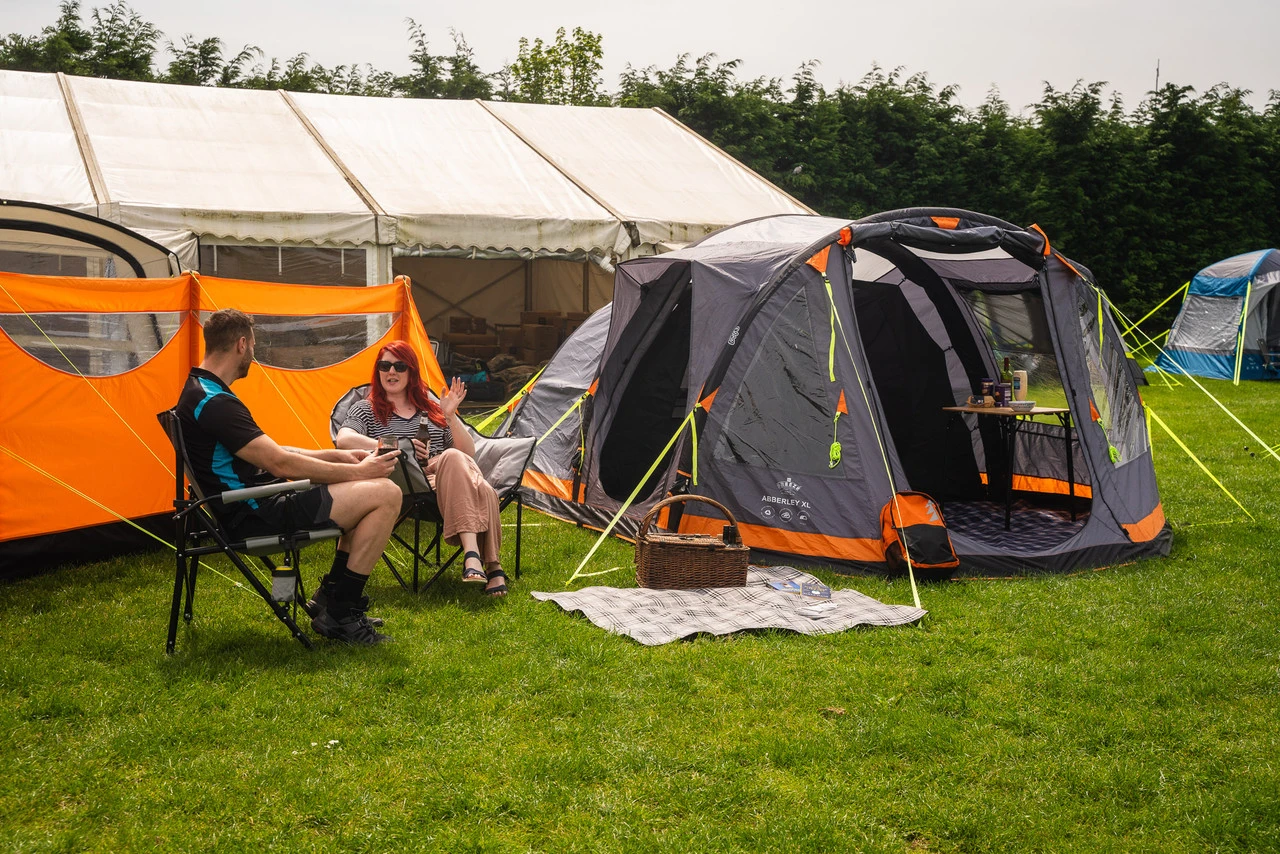
Our entry point to inflatable. Lightest in the range at 16.5kg with the most compact pack size. Darkened sleeping pods with a removable divider. Made with OLTECH REPRO fabric (recycled plastic bottles). Best for couples or small families wanting to try inflatable without the premium price.
Couples or small families wanting to try inflatable without the premium price. Lightest in the range at 16.5kg.
Blakedown Breeze (£649)
Two tinted roof skylights make the living area feel open and airy. Nine windows total. Generous front canopy. 5,000mm HH. Best for families of 3-4 who want a balance of space, features, and price.
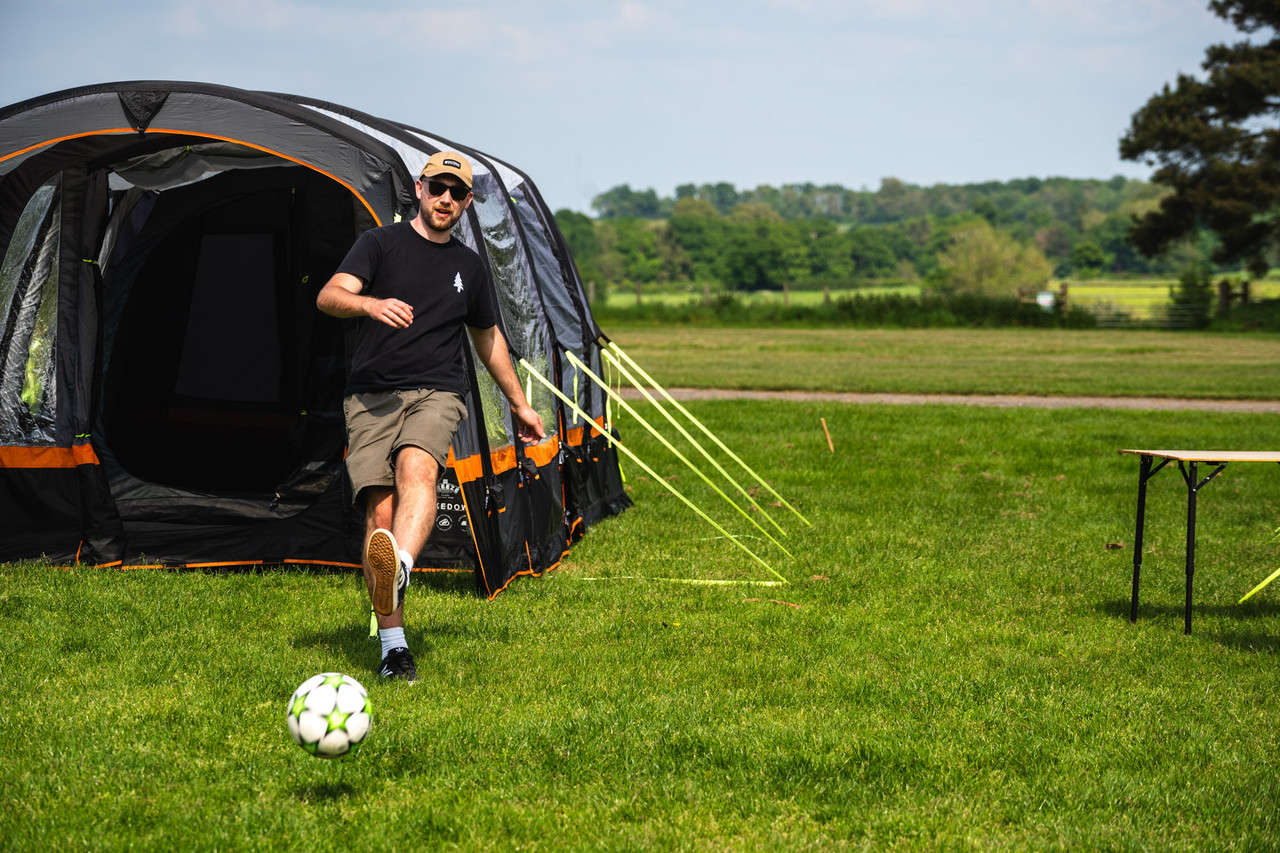
Families of 3–4 who want a balance of space, features, and price. The skylights make the living area feel open and airy.
Discovery (£899)
Our largest inflatable tent. Three doors, seven windows, a large enclosed front canopy with its own groundsheet, and a 5-berth inner tent. 50kg load capacity on the frame. Comes with a spare air beam, the only tent in our range that includes one. Best for larger families or groups who want serious living space.

Larger families or groups who want serious living space. The only tent in our range that includes a spare air beam.
Every OLPRO inflatable tent includes: manual pump, full peg set, guy ropes, storm straps, carry bag, repair kit, and bedroom inners. Lifetime warranty and free UK delivery.
Pitching, Packing and Looking After Your Air Tent
Quick reference: looking after your air tent
- ✓ Choose your spot before unrolling — moving a half-inflated tent is miserable
- ✓ Peg the corners before inflating to stop the tent shifting or catching wind
- ✓ Inflate to 7 PSI — not more, not less
- ✓ In wind, face the lowest profile towards the wind and inflate windward beams first
- ✓ Open every valve and squeeze the air out — don’t just open and hope
- ✓ Fold in half lengthways, then roll from the opposite end to the valves
- ✓ Don’t force it into the bag — if it won’t fit, unroll and fold more tightly
- ✓ After every trip: Wipe down, brush off grit, dry thoroughly before packing
- ✓ Once a season: Check valves for slow leaks, inspect seams and zips, check pegging points
- ✓ Storage: Somewhere cool, dry, out of sunlight — loosely folded, not compressed in the carry bag