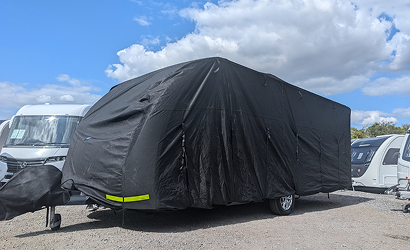
Written by Lisa Walton on 31st Mar 2026

Your caravan spends most of its life parked. Even the most enthusiastic caravanner might use their van forty or fifty nights a year -- which means it sits on the drive, in storage, or on a seasonal pitch for the other 300+ days.
Those 300 days of UV, rain, frost, bird droppings, tree sap, and road grime do more damage than the camping ever does. A cover won't make your caravan immortal, but it will dramatically slow down the deterioration that turns a pristine van into a faded, streaky, leaking one.
According to the Caravan and Motorhome Club, a properly fitted cover can prevent up to 60% of the wear and tear caused by environmental factors. That's significant -- both for the life of your van and its resale value.
A high-quality caravan cover provides year-round protection. You’ll extend the lifespan of your vehicle and save on costly repairs down the line.
Lisa Walton — OLPRO
Are Caravan Covers Worth It?
Yes -- but only if you buy the right type and fit it properly. A good cover protects against:
UV damage. The single biggest long-term threat to a parked caravan. UV degrades paintwork, cracks rubber seals, yellows plastic windows, and fades decals. A cover with UV-resistant coating blocks this entirely.
Rain, frost and damp. Standing water finds its way into seals and joints over time. Frost expansion opens up hairline cracks. A waterproof cover keeps moisture off the exterior surfaces where it does most damage.
Bird droppings and tree sap. Both are acidic. Leave bird droppings on paintwork for a week and they'll etch a permanent mark. Tree sap bonds to surfaces and pulls paint off when removed. A cover stops these landing on the van in the first place.
Dirt, dust and pollution. A covered caravan needs far less cleaning. No green algae streaks building up over winter. No road film from nearby traffic. When you're ready to use it, the van underneath is clean and ready to go.
Accidental damage. Falling branches, hailstones, careless neighbours in a storage compound. A cover is a buffer.
One of our customers put it bluntly: he'd previously bought a specialist bespoke cover costing six times the price of ours. The OLPRO cover, he said, was better quality, better fit, and arrived the next morning. The price doesn't have to be painful for the protection to be real.
Myths That Put People Off
"Caravan covers cause damp"
The key difference
Non-breathable covers trap moisture underneath, leading to condensation and damp -- the exact problem you’re trying to prevent.
Breathable covers (like OLPRO’s 4-ply polypropylene) let moisture vapour escape while keeping liquid rain out -- the same principle as a good waterproof jacket. Always choose breathable.
This is the most common concern -- and it's half true.
Non-breathable covers do cause problems. A cheap plastic tarpaulin or a cover made from non-breathable material traps moisture between the cover and the caravan surface. Water condenses underneath, can't escape, and creates the exact damp conditions you're trying to prevent.
Breathable covers don't. A properly made breathable cover allows moisture vapour to pass through the fabric while keeping liquid water (rain) out. Our 4-ply polypropylene construction is specifically designed for this -- the inner layers allow trapped moisture to escape while the outer layer repels rain. This is the same principle as a good waterproof jacket.
The key is airflow. Even with a breathable cover, make sure it's not so tight that there's zero air gap between cover and caravan. A small amount of airflow underneath the fabric helps moisture evaporate rather than sitting on the surface.
"Caravan covers cause damp"
An ill-fitting cover that flaps in the wind will abrade your paintwork over time. That's a fitting problem, not a cover problem.
A correctly fitted cover with adjustable straps, an elasticated hem, and non-abrasive inner fabric (like our non-woven polypropylene) sits snugly against the van without movement. No flapping, no scratching.
"Caravan covers cause damp"
It's not a one-second job, but it's entirely manageable solo. Position the cover over the front, walk it over the roof (a soft broom or step ladder helps), and secure the straps. Our fitting guide below takes you through it, and we have a YouTube video showing the whole process.
How to Measure Your Caravan for a Cover
Getting the size right matters. Too large and the cover flaps in wind, causing the very abrasion you're trying to prevent. Too tight and it strains over corners and fixtures, risking tears.
What to Measure
Length (most important): Measure the body of the caravan from front panel to rear. Do NOT include the A-frame or tow hitch -- covers are sized by body length only. Measure along the side of the van, not over the roof.
Width: Measure the widest point from side to side. Most UK caravans are between 7ft and 7ft 6in wide. Our covers fit caravans up to 7ft 5in wide, which covers the vast majority of touring caravans on UK roads.
Height: Measure from ground to the highest point including the roof. This is less critical than length -- most covers have enough vertical material to accommodate standard roof heights.
Not sure? Go up a size. A slightly loose cover with properly tensioned straps is better than a tight one that strains over fixtures.
If you're between sizes, go up. A slightly loose cover with properly tensioned straps is far better than a tight one that strains over every corner and protrusion.
Watch for protrusions: TV aerials, satellite dishes, solar panels, bike rack mounts. Either remove them before fitting or account for them in your measurements. Sharp protrusions can puncture the cover from underneath -- pad them with foam or remove them entirely.
If you're also sizing a caravan awning, the measuring process follows the same logic. Our caravan awning size and fitting guide covers awning-specific measurements in detail.
What to Look for in a Caravan Cover
Breathability
Non-negotiable. Any cover that isn't breathable will cause more problems than it solves. Look for multi-layer fabric construction where the outer layer repels water and the inner layers allow moisture vapour to pass through. Our 4-ply polypropylene does exactly this.
Waterproof Outer Layer
The cover needs to keep rain, snow, and heavy dew off your caravan. The outer layer should be properly waterproof -- not just water-resistant. Our cover uses a 160gsm 4-layer non-woven polypropylene on the roof (where water impact is greatest) and 100gsm on the sides.
UV Resistance
A cover without UV-resistant treatment will degrade in sunlight within a season or two. UV-resistant coating protects both the cover itself and the caravan underneath.
Secure Fit
Adjustable straps with quick-release buckles, an elasticated hem at the bottom, and underside securing straps that fasten beneath the caravan. The cover should sit snugly without flapping. Ours also has four reflective safety straps (two front, two rear) for visibility in storage yards and on driveways.
Zippered Access
Three zippered panels on the door side let you access the caravan interior without removing the entire cover. Essential for checking on the van, airing it out, or grabbing something from inside during storage.
Our Caravan Cover Range
Breathable Waterproof 4-Ply Caravan Cover -- £89 to £125
Our main caravan cover, available in six sizes from 12ft to 25ft.
What's included:
- 4-ply breathable waterproof cover
- Free hitch cover (worth £8)
- Free storage bag
- Adjustable underside securing straps
- 3 zippered access panels
- 4 reflective safety straps
- Elasticated hem
Material: 160gsm 4-layer non-woven polypropylene (roof), 100gsm (sides). Breathable, waterproof, UV-resistant, soft inner surface that won't scratch paintwork.
47 customer reviews. One reviewer, previously disappointed with a specialist cover costing six times more, said our cover beat it on quality, fit, and strap security.
Complete Protection System
For full coverage, we also make vehicle accessories including:
The towing cover is a separate product from the storage cover. It fits the front panel only, has integrated LED lights for visibility while towing, and weighs just 1.65kg. Universal fit for caravans between 7ft 6in and 8ft wide.
If you travel in a campervan rather than a caravan, our complete guide to campervan awnings covers the right awning options for your vehicle.
How to Fit a Caravan Cover
Before You Start
Clean your caravan and make sure it's dry. Fitting a cover over a dirty or damp caravan traps grime and moisture against the surface -- exactly what you're trying to avoid.
Remove or pad any sharp protrusions: TV aerials, bike rack mounts, solar panel brackets. Anything that could puncture the cover from underneath.
Watch our full caravan cover fitting video
Fitting your caravan cover: step by step
Identify front and rear (labelled on the cover) and which side has the zip panels -- these go on the door side.
Lift the front of the cover over the nose of the caravan. A step ladder or a soft broom to push the fabric up and over helps here.
Pull the cover from front to back, working it over the roof and down the sides. Take your time -- forcing it catches on corners and fixtures.
The elasticated hem should sit around the lower edge of the caravan body.
Starting from the back, thread the underside straps beneath the caravan and fasten with the quick-release buckles. Work forward, tensioning evenly. The cover should sit snugly without being drum-tight.
Make sure the zip panels line up with your door(s). Adjust the cover position before fully tightening all straps.
Pull it over the A-frame and tow ball area and secure with the attached straps. The hitch cover is included free with every OLPRO caravan cover.
Storage Covers vs Towing Covers
These are different products for different jobs. You need to know which one you're after.
You might use both -- the towing cover for transit days, the storage cover for everything in between.
Cleaning and Maintaining Your Cover
Cover care guide
- Brush off loose debris with a soft-bristled brush -- no stiff brooms.
- Wash with mild soap and warm water. Soft cloth or sponge in gentle circular motions. No bleach, no harsh detergents, no pressure washers.
- Rinse thoroughly. Soap residue compromises breathability.
- Air dry completely before packing away. Never store damp -- mould grows on wet fabric.
- › Inspect after storms for damage. Repair small tears immediately with adhesive patches.
- › Check straps and buckles for wear. A loose strap means a flapping cover, and a flapping cover means abrasion.
- › Store in the bag when not in use. Keep in a cool, dry place away from direct sunlight.
A well-maintained cover lasts several years. Ours comes with our lifetime warranty for additional peace of mind.