Written by Gareth Walton on 23rd Mar 2026

A driveaway awning does one thing that no other type of awning can: it stays standing when you leave.
Set up at your campsite, unclip from the van, drive to the beach or the pub or the supermarket, and come back to find your chairs, table, and sleeping setup exactly where you left them. No packing down. No repitching. Just reconnect and you're home.
It's the reason driveaway awnings are the most popular type for campervans and motorhomes, and it's the core of what we design at OLPRO. If you're new to awnings, our complete guide to awnings covers the fundamentals. This guide goes deep on driveaway models; how they work, how they attach, which accessories you need, and how to choose the right one including how to fit one to a wind-out awning, which is a question we get asked constantly.
What Is a Driveaway Awning?
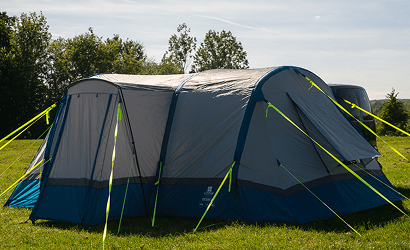
A driveaway awning is an enclosed shelter that connects to the side (or rear) of your vehicle via a detachable tunnel. When connected, it's a room extension, living space, dining area, bedroom, storage. When disconnected, it stands independently on its own frame while you drive away.
The "driveaway" part refers to that detachable connection. A fixed awning is physically anchored to your vehicle and has to be taken down before you move. A driveaway detaches in under a minute, stays pegged in place, and reattaches when you return.
When we surveyed our customers, 40% told us they use their driveaway awning as their main sleeping area. For many families, the kids sleep in the awning while the parents take the van, or the other way around. It effectively turns a campervan into a multi-room setup.
How Driveaway Awnings Attach to Your Vehicle
There are three main methods. Which one you use depends on your vehicle and how permanent you want the connection to be.
1. Awning Rail + Driveaway Kit (Most Secure)
The gold standard. Your vehicle has a C-channel or Reimo rail mounted along the side at roof height. The awning tunnel has beading that slides into this rail, creating a tight, weatherproof seal along the full length of the connection.
When you want to drive away, you slide the beading out of the rail. The awning stays standing on its own frame and pegs. When you come back, you park in the same spot (mark your wheel position with chalk or a peg) and slide the beading back in.
This is the method we recommend for anyone who'll use an awning regularly. It gives the tightest seal against rain and wind, and the connection is quick to make and break once you've done it a couple of times.
What you need: An awning rail on your vehicle (factory-fitted or aftermarket — our C-channel rail is £22 for three 100cm strips), plus a driveaway kit to connect the awning tunnel beading to the rail.
2. Throw-Over Storm Straps (No Rail Required)
Straps go over the roof of your vehicle and secure to anchor points on the far side, pulling the awning tunnel tight against the van. No drilling, no rail, no permanent modification.
Every OLPRO awning includes storm straps as standard. They're the easiest way to get started, just strap, tension, and go. The trade-off is a less weatherproof seal at the junction between tunnel and van. Wind can get underneath, and heavy rain may find its way in at the join.
What you need: Nothing extra — storm straps are included with every OLPRO awning. Consider our strap protectors (£9 for 3) to prevent the straps abrading your van's paintwork.
3. Magnetic Driveaway Kit (Quick and Non-Permanent)
A magnetic bar clamps to the metal roof of your van, and the awning tunnel connects to it. Quick to attach and remove, no modification needed. Ideal for people who don't want to drill an awning rail or who use a van that isn't their own (rental, borrowed, shared vehicle).
The magnets are strong, ours hold firmly in normal conditions. But in serious wind, a magnetic connection isn't as secure as a rail. And it won't work on non-metal surfaces (pop-top roofs, GRP panels).
What you need: Our Magnetic Drive Away Kit at £35.
Our recommendation
Start with storm straps to try awning camping. If you’re hooked (and you will be), fit an awning rail — it’s an afternoon’s work and the improvement in seal quality and ease of connection is immediate.
How to Fit to a Wind-Out Awning
Got a wind-out awning already?
All OLPRO awnings are compatible with all Fiamma, Thule, Omnistor, and other wind-out awning brands. You just need a 4–6mm driveaway kit (£20) to bridge the connection.
This is one of our most-asked questions. If your van already has a wind-out (roll-out) awning, the type made by Fiamma, Thule, Dometic, or Omnistor that rolls out from a cassette on the side of your vehicle, you can attach a driveaway awning to it.
All OLPRO awnings are compatible with all Fiamma, Thule, Omnistor, and other wind-out awning brands.
Here's how it works:
What You Need
- A 4-6mm driveaway kit (£20). This contains:
- A keder strip (double-sided awning tape) — 4mm on one side, 6mm on the other
- A figure-of-eight connector channel — joins the keder strip to your awning tunnel
The 4mm side slides into the C-channel on the edge of your wind-out awning. The 6mm side connects to the figure-of-eight channel, which your driveaway awning then slides into.
Step by Step
1. Extend your wind-out awning slightly. just enough to access the C-channel along its leading edge. You'll see a narrow groove running the length of the awning arm.
2. Slide the keder strip into the C-channel, 4mm side in. Push it along the full length of the channel.
3. Attach the figure-of-eight connector to the 6mm side of the keder strip.
4. Slide your driveaway awning tunnel into the other side of the figure-of-eight connector.
5. Position and peg the driveaway awning, making sure it's aligned with your van.
6. To drive away: slide your awning tunnel out of the figure-of-eight. The keder strip stays in the wind-out awning. The driveaway awning stands on its own frame.
7. To reconnect: park in the same spot and slide the tunnel back into the figure-of-eight.
The whole connection takes about five minutes once you've done it a couple of times. The figure-of-eight acts as a bridge between two different systems, which is why it works with virtually any brand combination.
Which Driveaway Kit Do You Need?
You can use this widget to input text into the page.
Not sure which rail you have?
Measure the width of the groove. 6mm is the most common for aftermarket awning rails. 4mm is standard on wind-out awning channels. If in doubt, our V2 awning tunnels have dual beading — both 4mm and 6mm — so they connect to either size without needing an adapter.
Driveaway vs Fixed: Which Is Right for You?
A fixed awning stays connected to your vehicle at all times while pitched. You can't drive away without taking it down. A driveaway disconnects and stays standing.
“Fixed awnings are great for convenience, but if you’re touring the Lake District one day and hitting the coast the next, a driveaway awning will save you hours and a lot of hassle.
For the vast majority of campervan and motorhome owners, driveaway is the right choice. The flexibility to leave your pitch set up while you explore is the entire point of campervan travel. Our campervan awning guide covers the full range of options for specific van models.
Can You Sleep in a Driveaway Awning?
Absolutely. 40% of our customers do.
A well-made driveaway awning with a sewn-in groundsheet, good waterproofing, and a bedroom inner is functionally a tent that happens to connect to your van. Our Cocoon Breeze V2 comes with a 5-berth inner tent as standard. The Hive Breeze has a 2-berth sleeping pod mounted to one side so it doesn't eat into your living space.
“Most people who own a campervan are desperate to save space. Using an awning for sleeping frees up so much space inside the van.
What makes an awning comfortable for sleeping
Sewn-in groundsheet. Non-negotiable. It keeps insects, draughts, and damp out. When we surveyed our customers, 100% said they wouldn't buy a tent or awning without one. Every OLPRO driveaway awning has a sewn-in groundsheet as standard.
Darkened bedroom inner. Blackout material so you're not woken at 5am by summer sunrise. Standard on our Cocoon and Hive models.
Ventilation. More bodies means more condensation. Open vents and mesh panels when sleeping in the awning to keep air circulating, even on cool nights. Our condensation guide covers the full picture.
A proper sleeping surface. The groundsheet protects you from the ground but it's not a mattress. An airbed, self-inflating mat, or camp bed makes the difference between a good night's sleep and a miserable one.
Comfortable sleeping checklist:
- ✓ Sewn-in groundsheet — keeps insects, draughts, and damp out (standard on all OLPRO awnings)
- ✓ Darkened bedroom inner — blackout material so you’re not woken at 5am by summer sunrise
- ✓ Ventilation — open vents and mesh panels to manage condensation, even on cool nights
- ✓ A proper sleeping surface — airbed, self-inflating mat, or camp bed makes all the difference
Our Driveaway Awning Range
Every awning below detaches from your vehicle and stands independently. All include storm straps, carry bag, pegs, and our lifetime warranty. 5,000mm waterproof rating across the range.
Inflatable
Poled
Essential Accessories
FAQ
Every OLPRO driveaway awning comes with a lifetime warranty, storm straps, carry bag, and free UK delivery.
Browse the full driveaway range →