Written by Daniel Walton on 8th Apr 2026

Walk into any camping shop and you'll see sleeping bags labelled with tog ratings, season ratings, EN temperature ratings, GSM fill weights -- or some combination of all four. None of them mean the same thing, and none of them tell you the full story.
This guide cuts through it. We'll explain every rating system, break down the different sleeping bag types, and give you a practical framework for choosing the right bag for UK camping -- whether you're car camping at a Dorset campsite in August or wild camping in the Brecon Beacons in October.
We've also folded in the warmth troubleshooting advice from our older posts, because "why am I still freezing?" is the question our customer service team hears more than any other.
Sleeping Bag Ratings Explained: Four Systems, One Goal
The outdoor industry uses four different ways to describe how warm a sleeping bag is. Here's what each one actually means -- and why you shouldn't rely on any single system alone.
Tog Ratings -- What They Actually Mean for Camping
A tog (Thermal Overall Grade) measures how well a fabric resists heat transfer. It's a UK textile standard -- the same one used on your duvet at home. Higher tog means warmer.
The problem: tog ratings were designed for duvets and baby sleeping bags, not camping sleeping bags. Most adult sleeping bags in the UK don't carry a tog rating at all. You'll find them on budget supermarket bags and some family camping ranges, but the rating method isn't standardised for sleeping bags the way it is for bedding. Two bags labelled "3 tog" from different brands may perform very differently.
That said, here's roughly how tog maps to camping conditions:
Treat as rough guidance. Tog ratings are not standardised for adult camping sleeping bags — always cross-check with season or EN/ISO ratings.
Treat these as rough guidance, not gospel. If a sleeping bag only gives you a tog rating, it's probably not been through any formal temperature testing.
Season Ratings (1-Season Through 4-Season)
This is the system most UK campers encounter first. It's simple, which is both its strength and its weakness.
Season ratings give you a quick shorthand, but they're not tested to any universal standard. One brand's "3-season" might be another's "2-3 season." Always check what temperature the rating is based on, if the manufacturer provides it.
Every sleeping bag in the OLPRO range carries a season rating: the envelope-style Hush and Dark Moon bags are rated 2-3 season, the Gecko mummy bags are rated 2-3 (Gecko 250) and 3-4 (Gecko 350), and the Kids bag is rated 2-season.
EN/ISO Temperature Ratings (Comfort, Limit, Extreme)
This is the most objective system. Sleeping bags tested to the EN ISO 23537-1 standard are placed on a heated thermal manikin wearing base layers, socks and a hat, on a sleeping mat with an R-value of about 5.4, inside a climate-controlled chamber. Sensors measure heat loss to produce three ratings:
- Comfort -- the temperature at which a standard woman (25, 60kg, 160cm) can sleep comfortably in a relaxed position. This is the rating you should buy on.
- Lower Limit -- the temperature at which a standard man (25, 70kg, 173cm) can sleep comfortably curled up. Less margin for error.
- Extreme -- the minimum survival temperature for six hours, with serious risk of hypothermia. Never use this as a buying guide. It's an emergency rating, not a comfort rating.
The OLPRO Gecko mummy bags are the only bags in our range independently tested to this standard:
* The Extreme rating is a minimum survival figure, not a comfort rating. Always buy on the Comfort rating. Both bags independently tested to EN ISO 23537-1.
We had both Gecko bags independently tested to EN ISO 23537-1 so customers can compare them properly against other brands. The Gecko 350 is comfortable down to about 5°C — that covers most three-season UK camping.
Gareth Walton — OLPRO Product Team
The caveats matter. ISO testing assumes you're on a decent mat, inside a tent, wearing dry base layers. If you're sleeping on a thin foam roll with no tent fly, the numbers won't hold. The test also can't account for your individual metabolism, body composition, hydration, or how tired you are. Use the Comfort rating as your baseline, and if you tend to sleep cold, go one season warmer.
GSM Fill Weight -- What 300gsm Actually Means
GSM stands for grams per square metre. It tells you the density of insulation packed into the sleeping bag -- how much fill there is per unit area.
Many family and recreational camping brands use GSM as their primary warmth indicator, including most of the OLPRO range. Here's roughly how it translates:
GSM measures fill density, not insulation efficiency. Only compare GSM figures between bags using the same fill type (synthetic vs synthetic, down vs down).
Important: GSM measures how much fill is in the bag, not how efficiently that fill insulates. A 300gsm down sleeping bag would be significantly warmer than a 300gsm synthetic one -- the down traps air more effectively per gram. GSM is only a fair comparison between bags using the same fill type.
The OLPRO envelope bags (Hush, Dark Moon, Stafford) all use 300gsm hollow fibre fill. The Gecko 350 uses a double-layer construction (2 x 125gsm) for 250gsm total but with better warmth distribution. The Gecko 250 uses 2 x 80gsm double layers.
How These Systems Compare
No two systems map perfectly onto each other, but this gives you a working reference:
Treat as approximate guidance. There is no exact formula converting these systems to each other.
Treat this table as approximate guidance. The relationship between these systems isn't exact -- there's no formula that converts 300gsm into a specific tog rating. But it gives you a way to compare bags that use different labelling.
What Type of Sleeping Bag Do You Need?
Mummy Sleeping Bags
Tapered from shoulders to feet, with an integrated hood. The mummy shape follows your body contour, which means less dead air space to heat. That makes them warmer for their weight and fill than any other shape.
The trade-off is room. Side sleepers and people who move a lot at night can find mummy bags restrictive. The nylon shells are also less soft against skin than the polycotton linings on envelope bags.
Mummy bags come with compression sacks, so they pack down smaller -- a real advantage if boot space matters.
OLPRO mummy bags:
Gecko 350

3-4 season, ISO-tested to Comfort 4.6°C. The warmest bag in the OLPRO range. Double-layer fill, internal pocket, compression sack. 1.9kg. From £25.
Gecko 250

2-3 season, ISO-tested to Comfort 10°C. Lighter at 1.4kg, packs smaller. Good for summer through early autumn. From £23.
Both are the only OLPRO bags with formal EN ISO temperature ratings, and at these prices they're hard to beat for a tested, named-brand mummy bag.
Rectangular / Envelope Sleeping Bags
The classic shape. Rectangular bags give you room to move, stretch out, and sleep in whatever position you like. Most can be fully unzipped to work as a flat blanket or duvet -- useful in warm weather or when you just want something to throw over yourself.
The polycotton inner lining on OLPRO's envelope bags is noticeably softer than the polyester lining on most mummy bags. If "sleeping bag comfort" means something close to your bed at home, this is the shape.
The downside: more internal space means more air to heat, so they're less thermally efficient. They also don't pack as small and tend to be heavier for equivalent warmth.
Hush Pattern Single
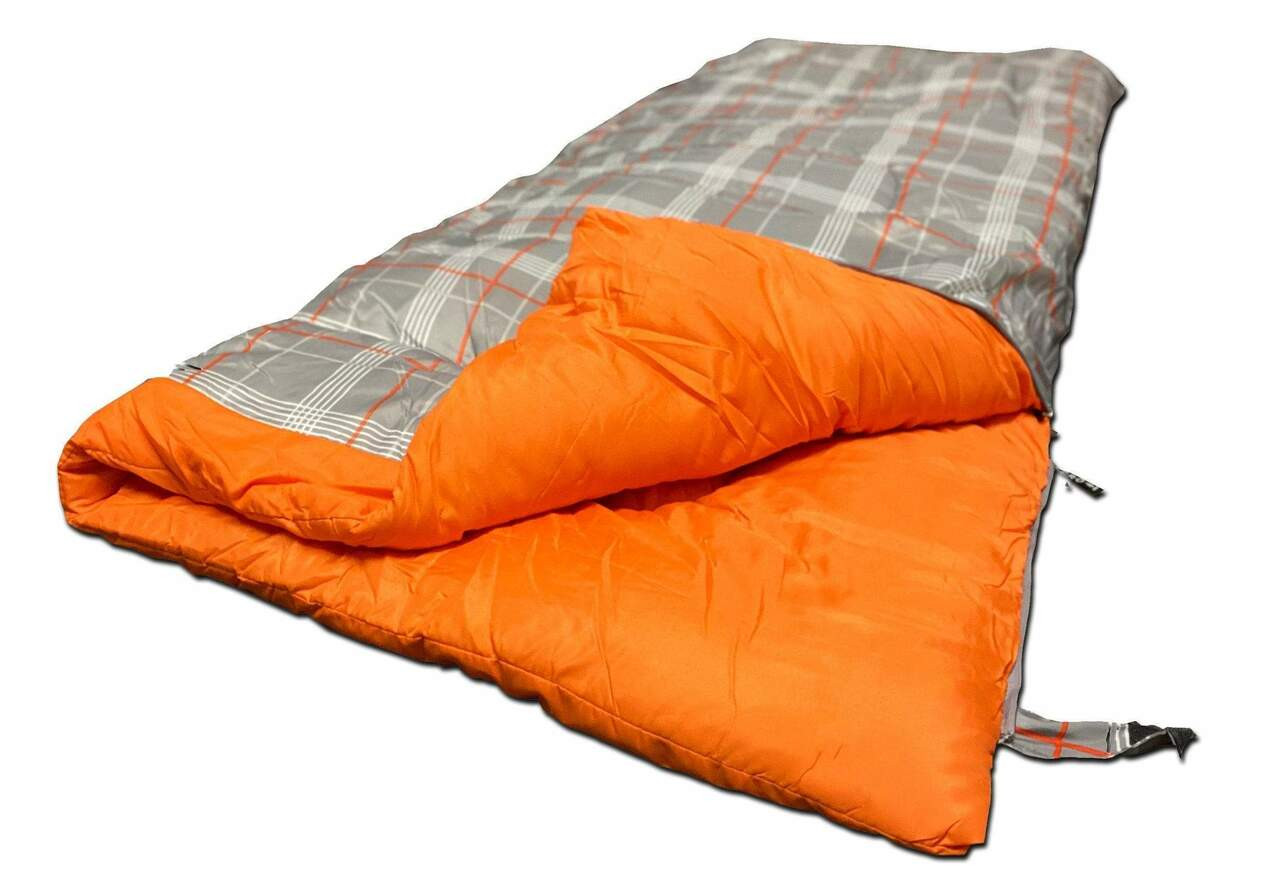
2-3 season, 300gsm hollow fibre, polycotton inner. 190 x 75cm. From £35
Dark Moon Pattern Single

Same spec as the Hush in a different pattern. From £39.
Hybrid and Double Sleeping Bags
Some bags don't fit neatly into mummy or rectangular.
The Stafford
(OLPRO x Ed Stafford) is a hybrid: rectangular body with an adjustable mummy-style hood and toggle. You get the room of an envelope bag with the head warmth of a mummy. At 220cm it's the longest bag in the OLPRO range -- good news if you're over six foot. The S-stitch construction keeps the 300gsm fill evenly distributed. At £19 (down from £48), it's arguably the best-value sleeping bag in UK camping right now.

Double sleeping bags are worth considering for couples. The OLPRO Dark Moon and Hush doubles (from £67) are actually two single sleeping bags zipped together -- so you can use them as a double or split them into two singles. That flexibility is genuinely useful. Doubles are less thermally efficient than singles (more air space, more heat loss at the zip junction), but the shared body warmth partly offsets this.
Kids Sleeping Bags
The number one mistake with kids and sleeping bags: putting a child in an adult bag. All that empty space around them is cold air the bag can't heat. A child-specific bag sized to their body retains warmth far more effectively.
The OLPRO Kids Patterned Sleeping Bag (from £16) is a mummy shape with a padded hood, sized at 160cm. The 2-season rating suits UK summer camping -- for shoulder-season trips, add a sleeping bag liner and a decent mat underneath.
Down vs Synthetic: Which Fill for UK Camping?
Down Sleeping Bags
Down insulation (goose or duck) has the best warmth-to-weight ratio of any fill material. It compresses to almost nothing, lasts decades if properly maintained, and breathes well.
The problems are real, though. Down loses most of its insulation when wet -- and in a British tent, some level of condensation is practically guaranteed. It's also more expensive, needs specialist washing (or careful hand-washing), and dries slowly. Ethically sourced down (RDS-certified) addresses welfare concerns, but it adds to cost.
Down makes sense for: backpackers counting grams, mountain campers with strong moisture management, and anyone willing to invest in careful maintenance.
Synthetic Sleeping Bags
Synthetic fills (hollow fibre, microfibre, brand-specific alternatives) retain their insulation when damp. That single fact makes them the practical choice for most UK camping.
They're also cheaper, easier to wash (most are machine washable at 30°C), hypoallergenic, and dry quickly. For families with children -- where sleeping bags get dragged through mud, spilled on, and need washing regularly -- synthetic is the obvious answer.
The trade-offs: synthetic bags are heavier and bulkier than equivalent-warmth down, don't compress as small, and lose their loft faster over time (expect 3-5 years of regular use before noticeable warmth loss, versus decades for well-maintained down).
The UK Weather Verdict
For family car camping at UK sites -- which is the majority of what our customers do -- synthetic wins. British weather is damp, tents condense overnight, and you need a bag that tolerates moisture without collapsing.
Every sleeping bag in the OLPRO range uses synthetic hollow fibre fill. It's a deliberate choice for our audience: families, festival-goers, and weekend campers who want warmth, easy care, and good value.
How to Choose the Right Sleeping Bag
Step 1: When and Where Are You Camping?
UK night-time temperatures drop much faster than most people expect. Here's what you're actually dealing with:
Typical lowland campsite overnight temperatures. Hilltop sites at 300m+ can be 3–4°C colder. Check overnight lows, not daytime highs.
The Practical Takeaway
- UK summer (June–August): A 2-season bag handles most lowland sites. A 2-3 season gives you a buffer for cooler nights.
- Shoulder season (April–May, September–October): 3-season minimum. Don't underestimate an October night.
- Winter (November–March): 4-season if you're camping at all. This isn't optional.
- Year-round versatility: A 3-season bag plus a sleeping bag liner covers the widest range of UK conditions.
Step 2: How Do You Sleep -- Hot or Cold?
Individual variation is huge. Two people in identical bags in the same tent will experience different temperatures. If you tend to feel the cold at home, buy one season warmer than the chart suggests. Always shop on the Comfort rating (or the more conservative end of the season range), not the Limit.
Women and older adults generally sleep colder -- this is physiological, not anecdotal. The EN/ISO Comfort rating is based on a standard female profile for exactly this reason.
Step 3: Will You Carry It or Drive?
Car camping: Weight and pack size are irrelevant. Go for comfort -- a rectangular or hybrid bag with a polycotton lining will feel more like your bed at home.
Backpacking or hiking: Every gram counts. A mummy bag with a compression sack (like the Gecko 250 at 1.4kg or the Gecko 350 at 1.9kg) makes a real difference over a multi-day route.
Campervan: You've got storage space but not unlimited -- a mid-weight bag that compresses reasonably is ideal.
Step 4: What's Your Budget?
Good sleeping bags don't need to cost a fortune. The OLPRO range runs from £16 (Kids) to £67 (doubles):
- Under £20: The Stafford at £19 -- hybrid design, 300gsm fill, Ed Stafford collaboration. Genuine value.
- £20–£40: Gecko mummy bags (£23–£25) with ISO temperature ratings, or the Hush/Dark Moon envelope singles (£35–£39) for more room.
- £50–£70: Double sleeping bags that split into two singles (£67).
If you're buying one bag for general UK camping, a 2-3 season bag in the £25–£39 range covers the vast majority of trips.
Why You’re Cold in Your Sleeping Bag (And How to Fix It)
The number one question we get after a chilly night is ‘is my sleeping bag faulty?’ Nine times out of ten, it’s not the bag.
Katie — OLPRO Customer Service
Your Sleeping Mat Is the Problem
This is the single biggest cause of cold nights that nobody talks about enough. The ground conducts heat away from your body roughly 25 times faster than air. Your sleeping bag compresses flat beneath your body weight, which eliminates its insulation on the underside. The bag keeps you warm on top. The mat keeps you warm underneath.
A decent self-inflating mat or insulated air mat with an R-value of 3 or above will transform your sleep. A thin foam roll won't cut it once temperatures drop below about 10°C.
We don't sell sleeping mats (it's not in our product range), but we'd rather tell you this than have you blame a perfectly good sleeping bag.
The Damp Clothing Mistake
Clothes you've worn all day absorb sweat, condensation, and ambient moisture. Sleeping in damp base layers dramatically increases heat loss through evaporative cooling. Change into a clean, dry set of thermals before getting into your bag. It makes a bigger difference than upgrading your sleeping bag by a full season rating.
More Reasons You're Waking Up Cold
Common reasons you’re waking up cold
-
#1 cause
Poor sleeping mat
The ground conducts heat away 25x faster than air. Your bag compresses flat underneath you -- the mat is what insulates you from below. Look for R-value 3 or above.
-
›
Bag rated too low for conditions
That warm evening was 18°C. It’s 5°C at 4am. Always check overnight lows, not daytime highs.
-
›
Sleeping in damp clothes
Clothes worn all day carry sweat and moisture. Change into clean, dry thermals before getting into your bag.
-
›
Head and feet exposed
A hat and warm socks make a measurable difference -- especially in a bag without a hood.
-
›
Empty stomach / dehydration
Your body generates heat through digestion. A slow-release carb snack before bed helps. Dehydrated bodies regulate temperature less efficiently.
-
›
Breathing inside the bag
Pulling the bag over your head creates moisture from your breath, dampening the fill and reducing insulation.
-
›
Bag stored compressed between trips
Keeping the bag in its stuff sack permanently compresses the fill and kills its loft. Store loosely in a cotton bag between trips.
For the full picture on warm camping techniques beyond the sleeping bag, see our complete guide to staying warm camping
A Blanko as an extra layer: If your bag isn't quite warm enough, layering an OLPRO Blanko over the top adds roughly the equivalent of a 2-3 season sleeping bag's worth of insulation -- the 250gsm microfibre fill and Sherpa fleece lining trap a significant amount of extra heat. It's a cheaper fix than replacing your bag entirely.
Sleeping Bag Care: Make It Last
A well-maintained sleeping bag holds its warmth for years. A neglected one loses it in one season.
Sleeping bag care guide
- ✓ Machine wash on a gentle cycle at 30°C with non-biological detergent
- ✗ No fabric softener -- it coats fibres and reduces their ability to trap air
- ✗ No bleach
- ✓ Wash every 50–60 nights of use, or at least once a year
- ✓ Tumble dry on low heat only -- high heat melts nylon and polyester
- ✓ Air-dry laid flat or draped over a line for 24–48 hours
- ✗ Never pack away damp -- mildew destroys insulation
- ✗ Never store compressed in the stuff sack. This is the number one thing that kills sleeping bag warmth over time.
- ✓ Store loosely in a large cotton or mesh sack -- a clean pillowcase works fine
- ✓ Stored properly, a synthetic bag retains its warmth for 5–8 years of regular use
Frequently Asked Questions
Find the right sleeping bag for your camping style
EN ISO-tested mummy bags • Polycotton envelope bags • Kids’ bags • Doubles • All with lifetime warranty and free UK delivery
Browse sleeping bags →