Written by Katie Martin on 3rd Mar 2026

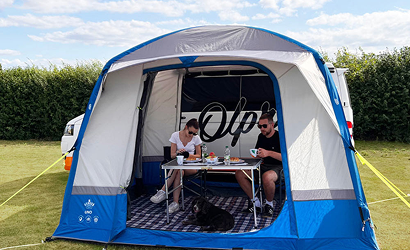
A camping awning is a sheltered structure that attaches to your vehicle and creates a sheltered living space beside it. Think of it as a room extension for your van, caravan, or motorhome.
We've been designing awnings at OLPRO since 2011. We've pitched them in horizontal rain on the Pembrokeshire coast, packed them away in Cornish mud, and tested prototypes on windswept campsites across the Malvern Hills, which is where our workshop is, so they get a proper beating before they ever reach a customer.
An awning is the single biggest upgrade you can make to your camping setup. It doubles your living space, gives you somewhere dry to cook and eat, and means your van or caravan stops feeling cramped by day two.
But choosing the right one is genuinely confusing. The market is full of jargon: driveaway, porch, full, Kador, figure of 8, beading, A-measurement, and most guides only cover one vehicle type. This guide covers the lot. Campervans, caravans, motorhomes. Inflatable and poled. From your first awning to your third.
What Exactly Is a Camping Awning?
Unlike a freestanding tent, an awning connects directly to your vehicle via a tunnel or rail system. That connection is what makes it an awning rather than just a tent pitched next to your car.
When we surveyed our customers, 72% said they use their awning for extra storage alongside another purpose, 70% use it as a dining area, and 40% use it for sleeping. Most people end up using it for all three.
Types of Camping Awnings Explained
Driveaway Awnings
The most popular type for campervans and motorhomes. A driveaway attaches to your vehicle but can stay standing when you disconnect and drive off, to the shops, the pub, or a day out. You drive back, reconnect, and you're home.
This is the type we make most of at OLPRO. The awning connects to your vehicle via a tunnel with beading that slots into your awning rail (or a driveaway kit). Detach the tunnel, and the driveaway awning stands independently on its own frame. Read through our driveaway awning guide for more information on this type.

Campervans and motorhomes where you want to leave the awning at your pitch while you explore.
Porch Awnings
A smaller awning that covers just part of the side of your caravan, like a porch on a house. Quick to pitch, lighter to carry, and a fraction of the cost of a full awning. They're ideal for weekend trips or touring where you're moving every few days.

Touring caravanners who don't want to pitch a full awning for a two-night stay.
Full Awnings
These run the entire length of your caravan's awning rail and essentially give you a room the same size as your caravan. Brilliant for longer stays but heavy, time-consuming to pitch, and expensive. You'll typically see these on seasonal pitches or fortnight holidays.

Caravan owners on extended stays or seasonal pitches.
Sun Canopies and Shades
Open-sided shelters that attach to your vehicle for shade and light rain protection. No walls, no groundsheet, just a roof. Quick to put up and pack away. We make several of these, from classic retro-striped designs to modern block-colour canopies.

Day shelter, fair-weather camping, or when you want shade without feeling enclosed.
Tailgate Awnings
Attach to the rear of your van rather than the side. These are newer to the market and work brilliantly with vans that have barn doors or a rear tailgate. The tailgate awning creates a sheltered space behind the van, useful for cooking, storage, or as a changing area.

Vans with rear barn doors, festival camping, surf trips.
Which Awning Fits Your Vehicle?
This is where most people get stuck. The answer depends on your vehicle height and type.
Campervans (Vehicle Height 190-250cm)
This covers most converted vans: VW Transporters (T5, T6, T6.1), Ford Transit Custom, Mercedes Vito, Renault Trafic, Vauxhall Vivaro, Mazda Bongo, and similar. Standard-height campervan awnings fit all of these.
Every OLPRO campervan awning fits 10+ different van makes. We use a dual beading system on our tunnels, both 4mm and 6mm, so the same awning connects to virtually any awning rail on the market. Read our complete campervan awning guide for more specific information.
Motorhomes (Vehicle Height 250-290cm)
Coachbuilt motorhomes, large panel van conversions (Fiat Ducato-based, Peugeot Boxer), and A-class motorhomes. These need a taller tunnel, we call ours the "Tall Tunnel" range.
We make the Cocoon Breeze and Loopo Breeze in Tall Tunnel versions specifically for this height range. Same awning, taller connection.
Caravans
Caravans use an awning rail built into the bodywork, running along the top edge. Sizing is done by "A-measurement", the distance in centimetres measured along the awning channel from one end to the other. You need to match your awning to this measurement.
We make porch awnings for caravans in 260cm and 390cm widths, plus larger inflatable porch awnings with extensions.
Not sure about your vehicle?
The simplest check: measure from the ground to the point where your awning rail sits (or where you'd mount one). Under 250cm = standard campervan awning. 250–290cm = motorhome/tall tunnel. For caravans, measure your A-measurement and match it to the awning size.
Inflatable vs Pole Awnings: The Honest Comparison
We make both. We'd love to tell you inflatable is always better, we invented our Breeze inflatable system and it's what we're known for. But the honest answer depends on what matters to you.
When inflatable is the right choice
You value quick, easy pitching, especially if you're often pitching alone. The Breeze system uses reinforced TPU (thermoplastic polyurethane) beams that you inflate with a hand pump. Our Cubo Breeze goes from bag to pitched in about 10 minutes. The beams flex in wind rather than fighting it, which actually makes them more resistant to storm damage than rigid poles.
“We designed the Breeze system because we kept watching people on campsites spending forty-five minutes wrestling with pole sleeves while their other half held the fabric in the wind. It shouldn't be that hard. Inflate, connect, done.
When poles are the right choice
Budget is your main concern, or you want the lightest possible awning. Our poled versions of the Cocoon, Hive, Cubo, and Hanley use fibreglass poles and cost £100-250 less than their inflatable equivalents. Same design, same fabric, same accessories, just a different frame system. We've put together a full inflatable vs pole comparison to help you decide.
How Awnings Attach to Your Vehicle
This is the bit that intimidates first-time buyers, but it's simpler than it looks. There are three main methods:
1. Awning Rail + Beading (Most Secure)
Your vehicle has a rail mounted along its side or roof edge (either factory-fitted or aftermarket). The awning tunnel has a strip of beading, a narrow rubber or plastic channel, that slides into this rail. This is the most secure, weatherproof connection.
Our awning tunnels now have dual beading (4mm and 6mm) to fit virtually any rail on the market.
For caravans, the awning rail is built into the bodywork. For campervans and motorhomes, you either have one factory-fitted (some VW California models) or you fit an aftermarket rail. VW T5 and T6 owners typically fit a C-channel rail along the roof gutter, it's a straightforward job with a drill and some sealant.
2. Throw-Over Storm Straps (No Rail Needed)
Straps go over the roof of your vehicle and tighten down on the other side. Less aerodynamic than a rail connection and not as waterproof at the join, but it works and requires zero modification to your vehicle. Every OLPRO awning includes storm straps as standard.
3. Magnetic Driveaway Kits
Strong magnets stick to the metal roof of your van, with the awning tunnel connecting to the magnetic bar. Quick to attach and remove, no drilling, no permanent modification. The trade-off is they're less secure in strong wind than a proper rail connection.
Our recommendation
If you're going to use an awning regularly, fit a proper awning rail. It takes an afternoon, costs around £40–80, and transforms how your awning connects and seals against the vehicle. If you're trying one for the first time and don't want to commit to a rail, start with storm straps.
How to Choose the Right Awning
Forget the specs for a moment. Start with three questions:
1. What Will You Actually Use It For?
Extra living space: You want a driveaway awning large enough to fit a table and chairs. Look at our Cocoon Breeze (455cm x 350cm) or Loopo Breeze (390cm x 310cm) for campervans, or the View 420 for caravans.
Sleeping extra people: You need an awning with an inner tent or sleeping pod. Our Cocoon Breeze comes with a 5-berth inner tent. The Hive Breeze has a clever 2-berth sleeping pod that sits to one side so it doesn't eat into your living space.
Shade and shelter only: A canopy is cheaper, lighter, and quicker. Open sides mean airflow on hot days. Our Modern Shade and Retro Shade canopies start at £155.
A bit of everything: Most people end up here. A mid-size driveaway awning (Loopo or Hanley size) with an optional inner tent gives you flexibility without bulk.
2. How Often Will You Pitch It?
Every weekend? Get an inflatable. The faster pitch time genuinely matters when you're setting up on a Friday evening after work. A few times a year? Poles are fine, the price saving makes more sense.
3. What's Your Vehicle and How Do You Travel?
Campervan, moving every few days: Driveaway awning. Disconnect, explore, reconnect. The Cubo Breeze or Uno Breeze at the compact end; Cocoon Breeze for full living space.
Caravan, touring: Porch awning. Quick to pitch and strike. Our View Lite range starts at £169 poled, £259 inflatable.
Caravan, staying put for a week or more: Full awning or a large porch awning with extension. Worth the extra pitch time when you're not moving.
Motorhome: Same as campervan, but check you need the Tall Tunnel version if your vehicle is over 250cm.
What Should You Budget?
Awnings range from under £100 to over £1,000. Here's what each price bracket gets you:
Our honest advice
If you'll use it more than four or five times a year, spend at least £400. A cheap awning that leaks, sags, or takes an hour to pitch will put you off awning camping entirely. A good one transforms every trip.
Our Range at a Glance
We make awnings for campervans, motorhomes, and caravans, in both inflatable (Breeze) and fibreglass pole versions.
Every OLPRO awning comes with:
- Lifetime warranty
- Storm straps included
- Carry bag included
- 5,000mm hydrostatic head waterproof rating
- Fully taped seams
- Sewn-in groundsheet (on enclosed models)
- Free UK delivery
Our newer models (Uno Breeze V2, Cocoon Breeze V2, Hanley Breeze) use OLTECH REPRO fabric, made from recycled single-use plastic bottles (8 bottles per square metre) without compromising on waterproofing or durability.
They also feature our AQUABARRIER zip system for water ingress prevention and TERRAGRIP pegging system that adapts to different ground conditions.