Written by Daniel Walton on 24th Nov 2026

Managing Director & Founder, OLPRO
Daniel founded OLPRO in 2011 and still leads its product design. He created the OLPRO Breeze inflatable system after watching too many campers wrestle with pole sleeves in the wind, and that fix-the-real-problem approach shapes everything the team builds and tests in-house.
Quick answer: yes, you can camp in a UK winter.
Choose a campsite that's open all year, and put your effort into how you sleep, not into the tent.
Winter campsites are quiet and often cheaper than in summer. The cold is the main thing to plan for, and most of that planning happens around your sleeping bag. This guide is about campsite trips. Wild camping and winter mountain trips are a different job, so we're not covering them here.
Why winter camping is worth it
Pitches are quieter, off-peak prices are lower, and frosty morning walks and big night skies come free. There are no midges either.
Where to go
Choose a campsite that's open all year. The Camping and Caravanning Club has year-round and extended-season sites, some open right through Christmas and New Year, and Pitchup lists campsites that are open all year. Ring before you book: a site being open doesn't mean its grass pitches are.
When you choose your pitch, look for somewhere:
- Out of the wind: behind a hedge or tree line.
- Off the valley floor: cold air pools there overnight.
- Close to the toilet block and car: a midnight walk is much shorter.
Sleeping warm: where winter camping is won
Many people expect the tent to keep them warm. It won't on its own. Warmth comes from a decent sleeping bag, a mat, extra layers, and spare clothes.
The Met Office's figures show how cold it gets: the UK's average overnight low is about 3.6°C in November, 1.4°C in December, 1.2°C in January, and 1.1°C in February. Those are averages for 1991 to 2020, and higher or more exposed ground is colder. All our sleeping bags are 2 to 3 season bags, so on their own they won't keep you warm on an average January night. We don't sell a winter sleeping bag or a sleeping mat, so here's what to look for, and how to get the most from the kit you have.
1. Under you. Cold comes up through the floor, so start there. Look for a mat with an R-value of 5 or more for November to March. R-value measures how well a mat stops heat escaping into the ground: the higher, the warmer. On a budget, lay a closed-cell foam mat under an inflatable one. A tent carpet or footprint adds another layer between you and a cold groundsheet, and we make both to fit specific tents.
2. Over you. From November, you want a 4-season sleeping bag, so buy or borrow one. Our sleeping bag tog guide explains how the ratings work. If you already own one of our bags, such as the Dark Moon or Hush (300g/m² fill, 190 x 75cm), add layers on top.
Our Original Insulated Blanko® makes a good top layer. It's 190 x 140cm, lined with Sherpa fleece, with a 250gsm microfibre fill, and it weighs 1.79kg. Lay it over your bag at night, then wear it round camp in the evening.
3. On you. Keep a dry set of clothes just for sleeping: a thermal top and bottoms, warm socks, and a hat. Never cotton, because it holds damp. Don't sleep in what you wore all day.
4. Before you get in. Eat a proper evening meal and keep a snack by your bag. Walk briskly for a few minutes to warm up. Fill a hot water bottle, seal it properly, wrap it in a sock or towel, and put it in the foot of your bag. Go to the toilet before bed, go easy on alcohol, and keep your face out of your bag: your breath makes the filling damp.
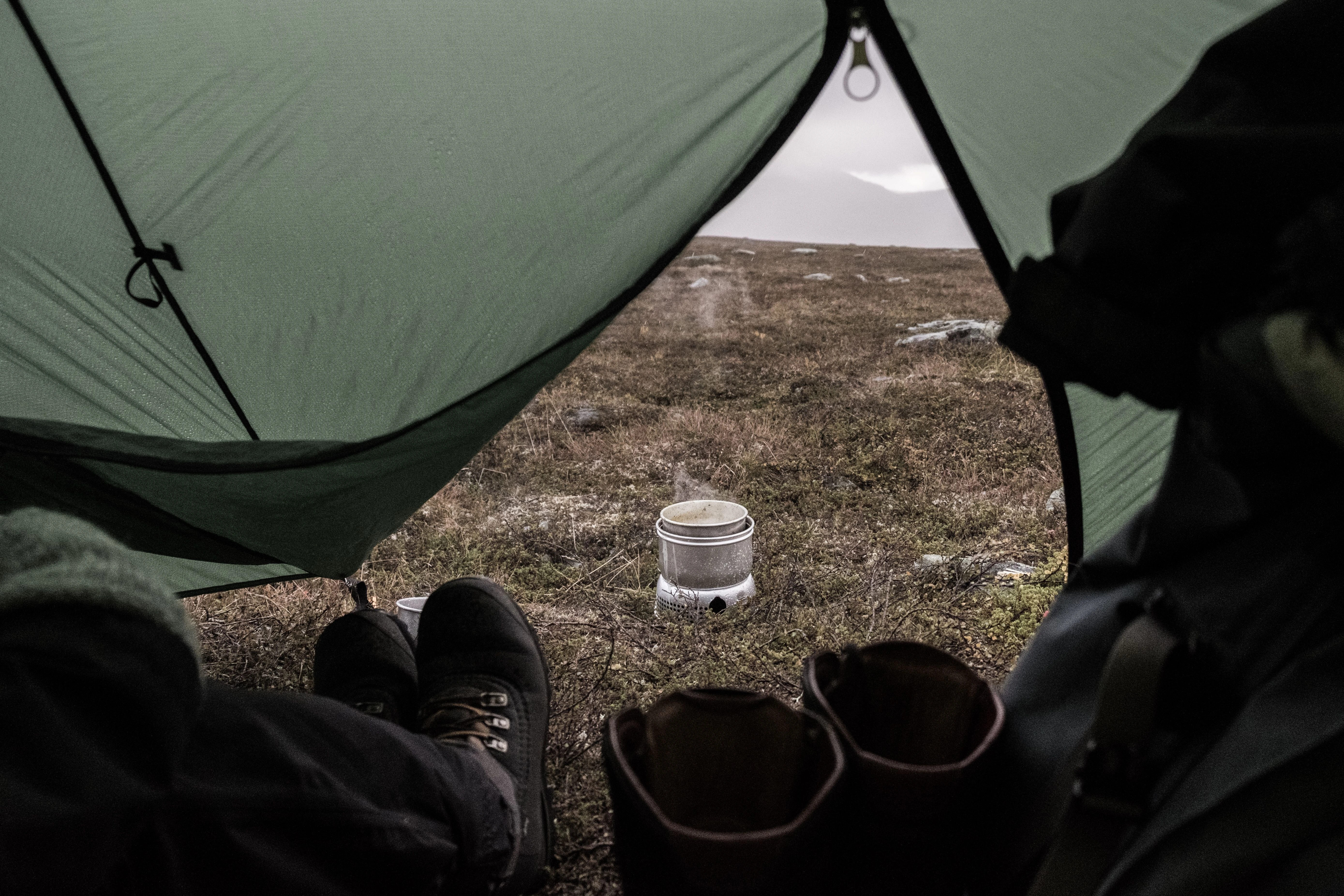
| What you need | From us? | What it does |
|---|---|---|
| Sleeping mat, R-value 5 or more | No | Stops the ground taking your heat |
| 4-season sleeping bag | No | Does the main job of keeping you warm |
| Original Insulated Blanko® | Yes, 1.79kg | Extra layer over your bag, and wearable round camp |
| Tent carpet or footprint | Yes, made for specific tents | Extra layer above a cold groundsheet |
| Dry sleeping set | No | Warm, dry clothes just for bed |
Scroll sideways on mobile.

The long, dark evenings
Around the shortest day, the sun sets just before 4pm in London and Manchester, and at about 3.40pm in Edinburgh. That leaves a long evening, so plan it.
- Eat early. Start cooking by about 4.30pm, while there's still some light.
- Cook outside. Never use a gas or fuel-burning stove or barbecue inside a tent or awning.
- Bring a light for everyone. A headtorch each keeps both hands free.
- Plan the evening. Cards, a flask of something hot, or a walk with torches. Put your warm layers on before you sit still, because that's when you'll feel the cold most.
Your tent, and keeping it dry
Winter camping isn't the time to find out where your tent leaks, so pitch it at home first. On site, pitch in daylight with the door facing away from the wind. Smaller tents warm up faster than big ones.
You can use any of our tents on a winter campsite. They aren't insulated, though, so we don't recommend them in snow, and they won't keep you warm on their own. Our small tents, the Solo, Beckford, and Defford, are rated 3-season. Our family tents don't carry a season rating.
Condensation is the winter tent problem. Your breath adds moisture, it settles on the cold fabric, and it drips back onto your bag. Keep some vents open, even when it feels wrong, and hang wet coats and boots in the porch, not above your bed.
When to call it off
With the right layers, most winter nights are fine, and the call is yours. Stay at home if a storm, heavy snow, or strong winds are forecast: check the forecast and any Met Office weather warnings for the area before you set off. Tell someone where you're going, and know how you'd get home or somewhere warm if the night turns bad.
One rule for the night itself: if you're still cold in your bag with every layer on, it won't get warmer at 3am. Warm up in the car and head home or somewhere warm.
Hypothermia: what to look for
The NHS lists the symptoms of hypothermia as shivering; pale, cold and dry skin; slurred speech; slow breathing; and tiredness or confusion. It's a medical emergency: go to A&E or call 999, and don't drive yourself.
If someone has hypothermia, don't use a hot bath, hot water bottle, or heat lamp to warm them up, don't rub their arms or legs, and don't give them alcohol.
Common questions
How cold is too cold to sleep in a tent?
It depends on your sleeping setup more than the tent. On a UK winter night, a 2 to 3 season bag on its own isn't enough: you need a 4-season bag, a mat with an R-value of 5 or more, and dry layers.
Which campsites are open in winter?
Plenty. The Camping and Caravanning Club has year-round and extended-season sites, and Pitchup lists campsites open all year. Ring first to check which pitches are open.
Can you use a heater in a tent?
Never use a gas or fuel-burning heater in a tent or awning. On electric hook-up, a low-wattage electric heater can take the chill off while you're awake and watching it. Keep it well away from tent fabric and bedding, and switch it off before you sleep.
Does a tarp over a tent keep it warmer?
We wouldn't suggest putting a tarp over your tent. In cold air, it won't add any warmth you'd notice. In snow, it can help by keeping snow off the tent fabric, so the tent stays slightly warmer. Otherwise, a tarp is more useful pitched separately as extra shelter.
Your next step
Ring a year-round site, check the forecast, and pack your dry sleeping set. For an extra layer at night and round camp, see our Original Insulated Blanko®. You can also browse our tents or read our full guide to staying warm whilst camping before you book.
An extra layer for cold nights
Lay an Original Insulated Blanko® over your sleeping bag at night, then wear it round camp in the evening.