Written by Daniel Walton on 9th Jul 2026


Managing Director & Founder, OLPRO
Daniel founded OLPRO in 2011 and still leads its product design. He created the OLPRO Breeze inflatable system after watching too many campers wrestle with pole sleeves in the wind, and that fix-the-real-problem approach shapes everything the team builds and tests in-house.
Yes, 3000mm is good enough for most UK camping. Step up to 5000mm for exposed pitches and autumn trips.
A waterproof rating is a hydrostatic head (HH) figure in millimetres. The higher the number, the more water pressure the fabric holds back before it leaks:
- 1500mm: the legal minimum to call fabric "waterproof". Fine for light showers only
- 3000mm: handles typical UK rain and showers. Good for most family camping, spring to early autumn
- 5000mm: heavy, persistent, wind-driven rain. Best for exposed sites, larger tents and autumn
- Groundsheet: needs a higher rating than the flysheet, because body weight forces water up through it
Every tent and awning spec sheet lists a waterproof rating in millimetres: 2000mm, 3000mm, 5000mm. The numbers look important, but the spec sheet rarely tells you what they mean or how much you actually need. The most common question we get is a fair one: is 3000mm enough, or should you pay for more?
The short answer: 3000mm keeps most UK campers dry, the groundsheet matters more than people think, and a high number on its own does not guarantee you stay dry. Here is what the ratings mean and how to read them.
Is 3000mm waterproof good enough?
For most UK camping, yes. A 3000mm flysheet handles the rain and wind-driven showers that define a British summer, and it is the rating OLPRO chose for its Hallow dome tent, described on the spec as "perfect for typical UK camping conditions". You will be fine on established campsites from spring through to early autumn.
Step up to 5000mm when the conditions get tougher: exposed or highland pitches, late-autumn trips, or a large family tent with big flat roof panels that hold water. OLPRO uses 5000mm on its bigger tents and the Stafford expedition range for exactly that reason. It is not that 3000mm fails, it is that 5000mm gives you more margin as the coating ages.
Tent waterproof ratings at a glance
| HH Rating | What it handles | Is it enough? |
|---|---|---|
| 1000-1500mm | Light showers, dry weekends | Festival and summer-only tents. The bare minimum |
| 2000-3000mm | Moderate rain, typical UK showers | Yes, for general UK camping and most family trips |
|
Sweet spot 3000-5000mm |
Heavy, persistent, wind-driven rain | Best for UK family camping and exposed sites |
| 5000mm+ | Extreme downpours, driving rain, snow | Wild, winter, mountain and highland conditions |
Ratings apply to the flysheet. Groundsheets need a higher figure (see below). Scroll the table sideways on mobile.
What hydrostatic head actually means
Hydrostatic head (HH) measures how waterproof a fabric is. The test is simple: stand a tube of water on a piece of fabric and keep adding water until it pushes through. The height of the water column at the point it fails, measured in millimetres, is the HH rating.
So a tent rated at 3000mm HH held back a 3000mm (3-metre) column of water before a single drop came through. 4000mm held back 4 metres, 5000mm held back 5.
For context, an umbrella rates about 420mm HH and keeps you perfectly dry, because it faces no pressure or abrasion. Tents need far higher ratings because rain hits the fabric under wind pressure, water pools on flat panels, and you brush against the walls. The fabric has to handle sustained pressure, not just falling drops.
In the UK, fabric is legally classed as "waterproof" at 1500mm HH. Legal minimums and staying comfortable through a Welsh October are different things, which is why most quality tents start at 3000mm.
Check out our video explainer if you need any further information on Hydrostatic heads:
The groundsheet matters more than the flysheet
This is the part people miss. Your groundsheet needs a higher rating than your flysheet, because it faces constant physical pressure. Your body weight, your knees and elbows, and your gear all push down and force water up through the fabric far more aggressively than rain hitting a sloped roof.
What rating does a groundsheet need?
| Groundsheet HH | Suitability |
|---|---|
| 2000-3000mm | Minimum, for basic camping on dry ground |
| 5000mm | Good for most UK sites |
| 10,000mm+ | Premium, handles wet ground, puddles and heavy dew |
A 5000mm flysheet with a 2000mm groundsheet leaks from below before it ever leaks from above. Check both.
If your tent has a sewn-in groundsheet, check its rating separately from the flysheet, because they are often different. A tent with a 5000mm flysheet and a 2000mm groundsheet will let water in from below long before it ever leaks from above.
Why a bigger number is not always better
The trade-offs of a higher rating
A higher HH is not a straight upgrade. It comes with trade-offs most guides skip.
Weight
More waterproofing means more coating on the fabric. A tent at 10,000mm HH is noticeably heavier than the same tent at 3000mm.
Breathability
Waterproof coatings, particularly polyurethane, reduce how well fabric passes water vapour. A higher HH can mean worse condensation inside, so you keep the rain out but trap your own moisture in. Our guide to avoiding condensation covers this in depth.
Stiffness and cost
Heavily coated fabric feels stiffer, is harder to fold, and costs more to make.
There is a reason ultralight tents use fabrics rated as low as 1200mm and still keep out heavy rain: a taut, pitched roof is under minimal abrasion, so it does not need the rating a groundsheet does. It is about matching the number to the stress the fabric actually faces. For UK family camping, 3000-5000mm is the practical ceiling. Going higher adds weight and cost without making you meaningfully drier.
We could build every tent to 5000mm and quote a bigger number, but that is not always the right call. Our dome tents are 3000mm because that is genuinely right for typical UK camping. We save the 5000mm coatings for the larger tents and exposed-pitch models where the extra margin earns its weight.
Daniel Walton
Managing Director, OLPRO
What about awnings?
Awnings face the same weather as tents but get overlooked when people check ratings. The same principles apply: the fabric has to handle sustained rain under wind pressure, and flat roof sections are prone to pooling.
For UK use, aim for the same 3000-5000mm range you would on a tent. Every OLPRO awning, campervan, motorhome and caravan, is built to 5000mm HH. Awning groundsheets matter too, especially if you sleep in the awning with an inner tent, so check that rating the same way.
What else keeps you dry

A high HH on the fabric is only part of the story. Water finds the weakest point, and that is rarely the middle of a panel.
Taped seams.
Every stitch hole is a potential leak. Quality tents have factory-taped seams that seal the holes with heat-applied tape. Check whether seams are fully or only partially taped, because the difference shows in heavy rain.
Zip covers and storm flaps.
Zips leak. A fabric flap over the zip redirects water away from the teeth. Door and window zips without storm flaps are one of the most common leak sources.
Design.
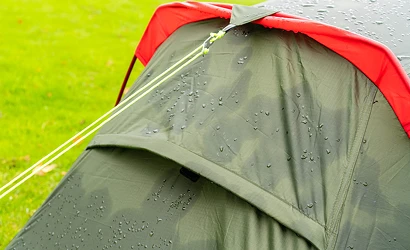
Steep walls and pitched roofs shed water. Flat panels let it pool, which puts far more sustained pressure on the fabric than rain alone. If you see water pooling on a roof, push it off rather than waiting for the fabric to cope.
Ventilation.
It sounds counter-intuitive, but good ventilation cuts condensation, which means less water dripping on you. A well-ventilated 3000mm tent feels drier inside than a sealed 5000mm one running with condensation.
Waterproofing degrades
Every coating breaks down over time. UV, folding, abrasion and dirt all wear it. A tent rated 5000mm when new might perform closer to 3000mm after three or four years of regular use. That is another reason to buy with headroom.
PU (polyurethane) coatings, used on most family tents and awnings including the OLPRO range, are effective but degrade faster than silicone. Silicone-treated fabrics (silnylon, silpoly) start lower but last longer, and are common on ultralight tents.
Keep your waterproofing working
Clean before storing
Dirt and grime speed up coating breakdown. Wipe the fabric down before it goes away for the season.
Always dry fully
Packing a damp tent grows mould and peels the coating. Pitch it at home to dry if you struck it wet.
Reproof every 2-3 years
A spray-on or wash-in treatment such as Nikwax Tent & Gear SolarProof or Fabsil restores lost water repellency.
Limit UV exposure
A week pitched in strong sun ages a coating more than a weekend away. Strike the tent during the day if you are not using it.
Frequently asked questions
From 3000mm dome tents to 5000mm family and expedition models.
Every OLPRO tent has taped seams, the right rating for the job, and a lifetime warranty.
Browse the OLPRO tent range →